Yes, you need a permit for an inground pool anywhere in New Jersey. The state's Uniform Construction Code (N.J.A.C. 5:23) requires construction permits for new work, including plumbing and electrical, and your township's construction office enforces it. Most Monmouth County towns also want zoning approval first, plus a fence that meets the pool barrier code before the pool is filled.
Do you need a permit for a pool in NJ?
Yes. New Jersey's Department of Community Affairs (DCA) says a construction permit is required for new construction and for structural, plumbing, mechanical and electrical work. An inground pool has all of that: excavation, a shell, plumbing, a pump, bonding and wiring. Ordinary maintenance is exempt; a pool isn't.
The permit belongs to the owner. DCA says the owner or an agent applies, and the owner is responsible for getting it. Your builder can file as your agent, but your name is on the jacket.
The state rules are the same in Holmdel and Howell. What changes from town to town is zoning: setbacks, lot coverage and the drawings each office wants. Our page on pool installation in Monmouth County walks through the whole project.
Who issues pool permits in Monmouth County
Your municipality does, not the county or the state. DCA explains that the Uniform Construction Code is enforced by State-licensed professionals employed by each town: a construction official who runs the office, subcode officials for building, electrical and plumbing, and inspectors. You deal with your own township hall, and its construction official signs off on the pool.
So Marlboro, Colts Neck, Wall Township and Middletown each have their own forms, fees and inspection calendars. The state code is the floor, and local zoning sits on top of it.
Pools fall under N.J.A.C. 5:23 through the International Swimming Pool and Spa Code (ISPSC). A July 2016 memo from DCA's Division of Codes and Standards told local officials the 2015 ISPSC had been adopted into the code. The Northeast Spa and Pool Association's New Jersey code page lists the current edition: Section R326 of the residential subcode points to the 2021 ISPSC, effective September 6, 2022.
Which permits a typical inground pool needs
A typical inground pool in Monmouth County needs a zoning approval plus a construction permit with building, electrical and plumbing subcode sections. Manalapan Township's residential pool application is a good example: zoning first, then a permit jacket with building, electric and plumbing subcode cards, and signed and sealed pool plans for inground pools.
Manalapan also wants filter information on the electrical application, a gas line drawing if you add a heater, and the pool barrier drawn on the zoning application, so the fence is approved before it's built.
| Approval | Who reviews it | What they look at |
|---|---|---|
| Zoning or land use approval | Zoning officer | Setbacks, rear yard location, lot coverage, fence location |
| Grading and drainage review | Town engineer, where required | Grading plan, drainage plan, sometimes soil borings |
| Building subcode | Building subcode official | Pool plans, the barrier under ISPSC Section 305 |
| Electrical subcode | Electrical subcode official | Bonding and grounding under NEC Article 680, pump and lighting circuits |
| Plumbing subcode | Plumbing subcode official | Suction outlets and entrapment, pressure test of piping |
| Mechanical or fuel gas | Subcode official, when a heater is added | Gas line drawing for the heater |
The subcode split comes from DCA's 2016 memo, which told inspectors to focus on entrapment (plumbing), barriers (building) and bonding and grounding (electrical).
Zoning: setbacks, lot coverage and the plot plan
Zoning sets where the pool can go on your lot, and it varies by town. West Long Branch's pool requirements sheet is one verified Monmouth County example: pools are allowed only in the rear yard, the water's edge must be at least 15 feet from any property line, and pool equipment must also sit 15 feet from property lines.
If the house forms one side of the enclosure, the water's edge must be at least 10 feet from it. The borough also wants a drainage plan, a grading plan and soil boring tests, all approved by the Borough Engineer before a permit is issued.
Lot coverage is the number that catches people. West Long Branch counts a pool toward impervious coverage, with limits of 40 percent in the R-10 zone, 38 percent in R-15 and 30 percent in R-22. If your house, driveway and patio already use most of that, a big pool and deck may need a variance. That's a zoning board hearing, and it adds weeks.
Don't use West Long Branch's numbers for your town. Freehold, Red Bank and Toms River set their own, so call your zoning office before you fall for a 40 foot model. In western Monmouth, see our Freehold pool installer page.
Why towns ask for a survey and grading plan
Zoning offices need a survey or plot plan to check setbacks against your lot lines. Grading matters because a pool and deck change how rain runs across the yard, and towns don't want it pushed onto a neighbor. West Long Branch also wants an as-built survey before its final certificate.
Sandy soil and high groundwater near the coast change how a pool is set, which is why our prefab concrete pool installs sit on a crushed-stone sub-base with subsurface drainage.
NJ pool fence requirements under the barrier code
New Jersey's pool barrier code is Section 305 of the ISPSC, which the state adopted into the Uniform Construction Code. The barrier must be at least 48 inches tall measured on the outside, gates must open outward away from the pool, and every gate must be self-closing and self-latching. Openings can't pass a 4-inch sphere.
Section 305, as reprinted in Spartanburg County's barrier handout, also caps the gap under the fence at 2 inches over soil or 4 inches over concrete. A residential latch that isn't self-locking must sit at least 54 inches up if reachable from outside.
Houses count too. When a wall of your home is part of the barrier, a door opening onto the pool area needs an audible alarm listed to UL 2017, and so do operable windows with a sill under 48 inches. Homeowners miss this one most.
A powered safety cover can change the math. The ICC's commentary on the 2021 ISPSC says a pool with a powered safety cover meeting ASTM F1346 doesn't have to comply with Sections 305.2 through 305.7, while a manual cover gets no relief. Your town may still demand a fence.
Towns can add rules. West Long Branch wants a lockable gate the same height as its 48 inch fence, won't accept temporary fencing, and bars filling the pool before the fence permit is issued.
The U.S. Consumer Product Safety Commission's June 2026 report found an average of 376 children under 15 drowned in pool or spa incidents each year from 2021 to 2023. Nearly 80 percent were younger than five, and more than 70 percent of the deaths happened at a home. CPSC recommends barriers, door alarms, covers and self-latching gates together.
Not sure what your township will ask for?
Baur Pools measures your yard, checks the zoning setbacks and builds the permit package for Monmouth and Ocean County towns. We quote after a site visit.
Book a free consultation Call 908-554-4647Call 811 before anyone digs
New Jersey law requires whoever is digging to call 811 at least three business days before excavation starts. NJ One Call says the service is free and it's the law, and you can also reach it at 800-272-1000. Utilities then mark their buried lines with paint before the dig.
NJ One Call's rule covers "contractors and property owners, whoever is excavating," so if you dig fence post holes yourself, the call is yours. It also warns that rain can wash marks away. Show your builder where any private lines you put in, like sprinklers or lamp post wiring, run.
HOA approval is a separate step
If you live in a community with a homeowners association, its architectural approval is separate from the township permit, and one doesn't replace the other. The township checks code and zoning. The HOA checks its own covenants, which can cover fence style and color, equipment screening and landscaping.
Get the HOA's written approval before you file with the town. If the HOA rejects a fence the township already approved, you're redrawing the barrier and refiling.
The inspection sequence, from bonding to final
A pool gets inspected in stages, and the work has to stop until each one passes. DCA says the permit holder notifies the construction office when work is ready, and inspections are generally done within three business days of the request. A final inspection comes before the town issues its closing certificate.
The order varies by pool type and town, but most inground jobs here follow this pattern:
- Excavation and footing or base check, where the town requires one.
- Bonding inspection before the deck is poured, so the electrical inspector can see the bonding grid around the pool.
- Plumbing pressure test of the pool piping before backfill and concrete cover it.
- Rough and final electrical for the pump, lights and any heater or automation.
- Barrier inspection of the fence, gates, latches and door alarms.
- Final building inspection and any as-built survey the town requires.
DCA's 2016 memo says pressure testing belongs in the inspection because it "is not easily addressed after concrete has been poured." Bonding is the same. When everything passes, DCA's process ends with a Certificate of Approval. Keep a copy with your house papers.
How long pool permit approvals take
Under the Uniform Construction Code, a township has 20 business days to approve or deny a complete construction permit application, according to DCA. Zoning review, engineering review of grading plans and HOA approval come before or alongside that clock, so the full paper process often runs longer than four weeks.
"Complete" is the catch. A missing survey or a barrier left off the zoning drawing stops the clock. Check the package before it goes in.
Once the permit is issued, don't sit on it. DCA says a permit becomes invalid if the work doesn't start within 12 months, or if work stops for six months after it starts. For a pool you want by Memorial Day, start the permits in winter.
Once excavation begins on a fiberglass pool in Monmouth County, shell placement and plumbing usually take two to four weeks, versus four to six months for gunite. The paperwork can take longer than the dig.
What happens if you build without a permit
Building a pool without a permit in New Jersey can cost you up to $2,000 per violation under N.J.A.C. 5:23-2.31, and the order to pay that penalty issues immediately once the town finds the work. The construction office can also issue a stop construction order, and each day you ignore it counts as a separate offense.
Cranford Township's construction page puts it as up to $2,000 per subcode, plus $2,000 per week the violations stay open. A pool touches three subcodes.
The bigger cost often comes at resale. A buyer's attorney can pull the township permit file, and a pool with no final approval gives the buyer a reason to renegotiate or walk. Legalizing it later is hard, because inspectors can't check piping or bonding under concrete, so some work may have to be opened up.
How Baur Pools handles the paperwork
Baur Pools handles the township paperwork for its pool installs: grading plans, zoning setback verification, electrical permits, fence enclosure inspections and scheduling the inspector visits. You sign as the owner, and we file and follow up with the construction office for you.
At the first consultation we measure the yard, which tells us early whether a 40 foot El Capitan from our fiberglass pool styles fits your setbacks or whether a compact Aurora, 16 to 26 feet long and 10 feet wide, is the better fit.
Each town runs permits a little differently. See our pool installer page for Red Bank and our Colts Neck pool installer page, or south of the county line, our pool installer services in Ocean County and the page for pool installation in Toms River. The full list of towns is on our Baur Pools service areas page.
We limit how many projects we run at once, so you deal directly with the crew. See finished work in our pool project gallery or read about the Baur Pools team. After final, sister company Baur Lawns can landscape around the pool.
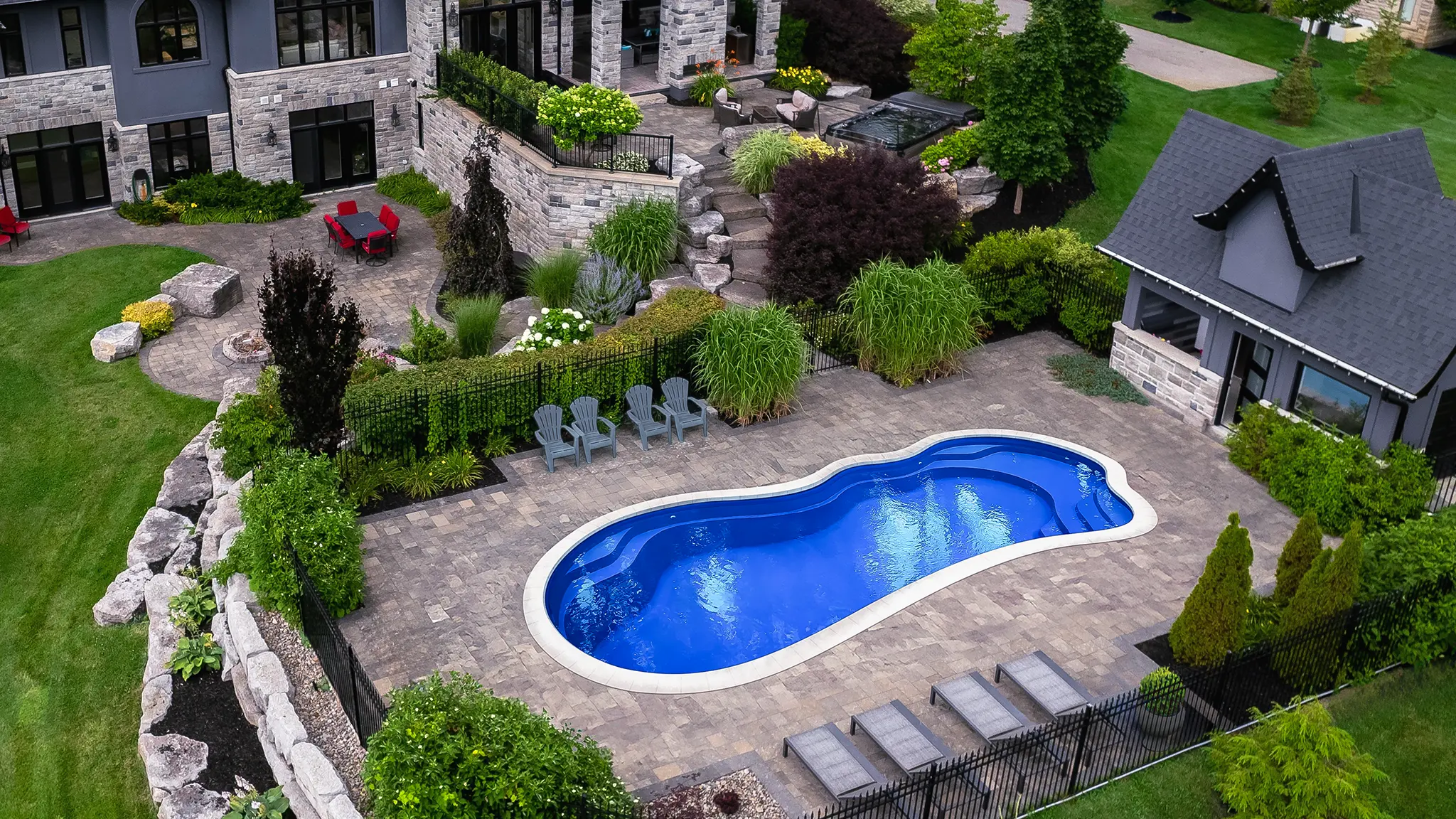
The permit drawings show the exact model and size, so settle your pick before filing. Our inground pools in Monmouth County page compares fiberglass, prefab concrete and tiled models.
Let us handle the township for you
From the grading plan to the final barrier inspection, Baur Pools files the permits and meets the inspectors. Call to set up a yard visit in Monmouth or Ocean County.
Book a free consultation Call 908-554-4647Frequently asked questions
Do I need a permit for a pool in NJ?
Yes. New Jersey's Uniform Construction Code requires a construction permit for new construction, including plumbing and electrical work, and an inground pool has all of it. Your township's construction office issues the permit, and most towns also want zoning approval and an approved pool barrier before the pool is filled.
How tall does a pool fence have to be in New Jersey?
At least 48 inches, measured on the side away from the pool, under Section 305 of the International Swimming Pool and Spa Code that New Jersey adopted. Gates must open outward and be self-closing and self-latching, and openings can't let a 4-inch sphere pass through.
Do I need a door alarm if my house is part of the pool barrier?
Yes. When a wall of the house forms part of the barrier, doors with direct access to the pool need an audible alarm listed to UL 2017 under ISPSC Section 305. Operable windows with a sill under 48 inches above the floor are covered by the same rule.
How long does it take to get a pool permit in Monmouth County?
The Uniform Construction Code gives a township 20 business days to approve or deny a complete construction permit application. Zoning review, engineering review of a grading plan and HOA approval can add more time, and a variance hearing adds the zoning board's schedule, so start in winter for a summer pool.
What happens if I put in a pool without a permit in NJ?
The township can issue an order to pay a penalty of up to $2,000 per violation under N.J.A.C. 5:23-2.31, plus a stop construction order. An unpermitted pool can also cause problems when you sell, because buyers can check the township's permit file for the house.
Do I have to call 811 before installing a pool in NJ?
Yes. NJ One Call says whoever is excavating must call 811 at least three business days before digging, and the service is free. Utilities then mark their buried lines. Point out any private lines you installed, such as sprinkler pipes or lamp post wiring, to your builder.
Does a pool builder near me pull the permits?
Many do. Baur Pools handles the township paperwork for its installs in Monmouth and Ocean County, including grading plans, zoning setback checks, electrical permits, fence enclosure inspections and scheduling inspector visits. The permit still belongs to you as the owner, so you'll sign the application.
More pool guides for New Jersey homeowners
Sources
- NJ Department of Community Affairs, Uniform Construction Code general information
- NJ DCA Division of Codes and Standards, Pools and spas memo (July 11, 2016)
- Northeast Spa and Pool Association, New Jersey codes, standards and regulations
- Spartanburg County, Swimming pool barrier requirements (ISPSC Section 305 text)
- International Code Council, Code Corner: 2021 ISPSC Chapter 3 general compliance
- New Jersey One Call, Training and safety
- Manalapan Township, Residential pool permit application
- Borough of West Long Branch, Swimming pool requirements (September 2022)
- N.J.A.C. 5:23-2.31, Violations, penalties and stop construction orders (Justia)
- Cranford Township, What if I do not get a permit?
- U.S. Consumer Product Safety Commission, CPSC report highlights persistent risk of childhood drowning (2026)
